Contact DE / EN
AI consulting · Focus 04

MCP servers & system integration

An MCP server (Model Context Protocol) connects an AI system to your existing IT systems and databases. Through that connection the AI can evaluate your data and interact with the software — reading as well as writing. We develop the MCP server to your requirements and set it up on a small server on your premises.

01Introduction

An MCP server connects an AI system to your existing IT systems and databases.

The MCP server (Model Context Protocol) forms the interface through which the AI accesses the connected systems — evaluating data and interacting with the software. We develop the MCP server to your requirements and set it up on a small server on your premises.

The result is secure, data-protection-compliant access from AI to your systems — from pure evaluation to active interaction in natural language.

Your own
server
Operated on a small server at your site — the data stays with you
Reading &
writing
Query data, write it back and trigger tasks in the systems
Built to
requirement
Developed individually for your systems and use cases

02What it makes possible

The MCP server connects a large language model (LLM) to the systems it is attached to. Users then work with the LLM in natural language — and the LLM accesses those systems through the MCP server, reading as well as writing. In concrete terms:

Evaluating dataThe LLM produces analyses and evaluations based on the existing data in the connected databases.
Presenting resultsIt writes reports and builds dashboards from the evaluated data.
Monitoring activelyIt issues warnings and notices as soon as defined conditions occur.
Interacting with systemsIt queries information, writes data back and triggers tasks in the systems — in a connected ERP system, for example.

Instead of formulating queries or working through input masks themselves, users describe what they need to the LLM in natural language; the LLM carries it out in the respective system through the MCP server. These examples are not exhaustive — depending on the connected system and the use case, many further applications are possible.
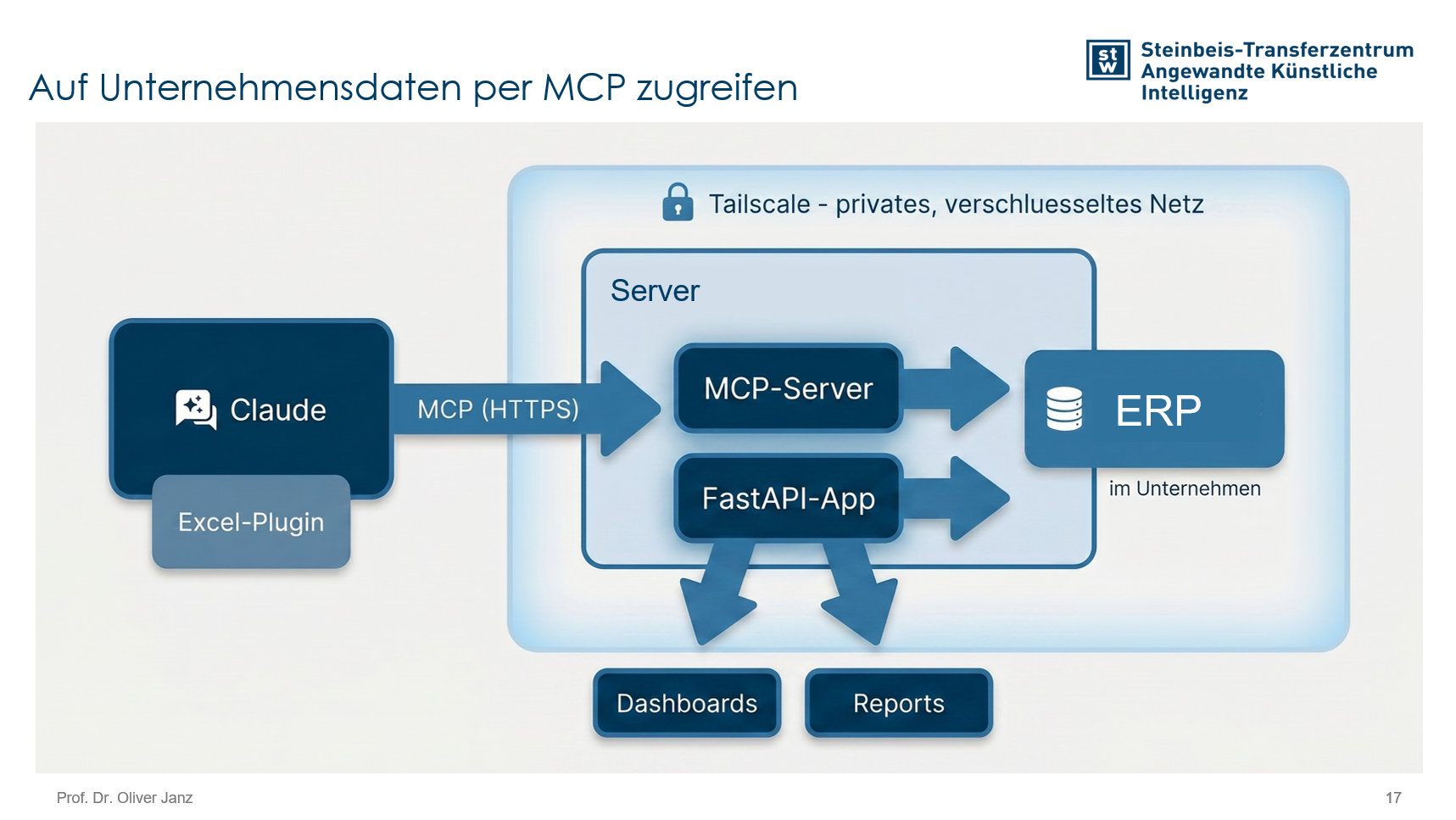
Diagram: Claude accesses an MCP server and a FastAPI app inside an encrypted Tailscale network via MCP over HTTPS; these connect to the company's ERP system and deliver dashboards and reports
Fig. 1 — Diagram: the AI accesses the ERP system and databases through the MCP server — reading as well as writing.

03How we proceed

  1. Analyzing use casesWe clarify what the MCP server is meant to achieve and which use cases exist for it.
  2. Assessing the benefitWe assess the value of each use case and prioritize accordingly.
  3. Analyzing systems & integrationWe analyze which systems need to be connected and which options for connecting them exist.
  4. Developing & testingOn that basis we develop and test the MCP server, using primarily Claude by Anthropic.
  5. Implementing & optimizing use casesOnce it is finished we implement the use cases with the MCP server, test again and optimize.
  6. Fine-tuning accessWe help ensure that the AI interprets the information from the systems correctly and, conversely, addresses those systems correctly.

04Security and functionality

  • Particular emphasis on cyber security and data protection
  • The functionality of the connected systems must not be impaired by the MCP server
  • Operated on a server belonging to you — the data stays under your control

05Scope of services

What we take on for the MCP server in concrete terms:

  1. 01Use case analysis and assessment for the MCP server
  2. 02Analysis of the systems to be connected and the options for connecting them
  3. 03Setting up the server belonging to you
  4. 04Development, testing and optimization of the MCP server
  5. 05Support during implementation of the use cases, including fine-tuning the AI's access

06Frequently asked questions

What is an MCP server?

An interface through which an AI system can securely access your existing IT systems and databases.

Where does the server run?

On a small server at your site, which we set up.

Which AI is used?

Primarily Claude by Anthropic.

Is ongoing operation affected?

No, the functionality of the connected systems remains untouched — that is a fixed part of our security concept.

What exactly can the AI do then?

Evaluate data, write reports, issue warnings and notices, build dashboards and interact with your systems in natural language.

07Who it is for

Suitable for companies that want to make their existing systems and data usable through AI without putting ongoing operations at risk.

The benefit: secure, data-protection-compliant access from AI to your systems — from evaluation through to interaction in natural language.
Let us talk about your use case.

Prefer to write directly? info@stzki.de

We use your details solely to answer your enquiry. More in our privacy policy.